
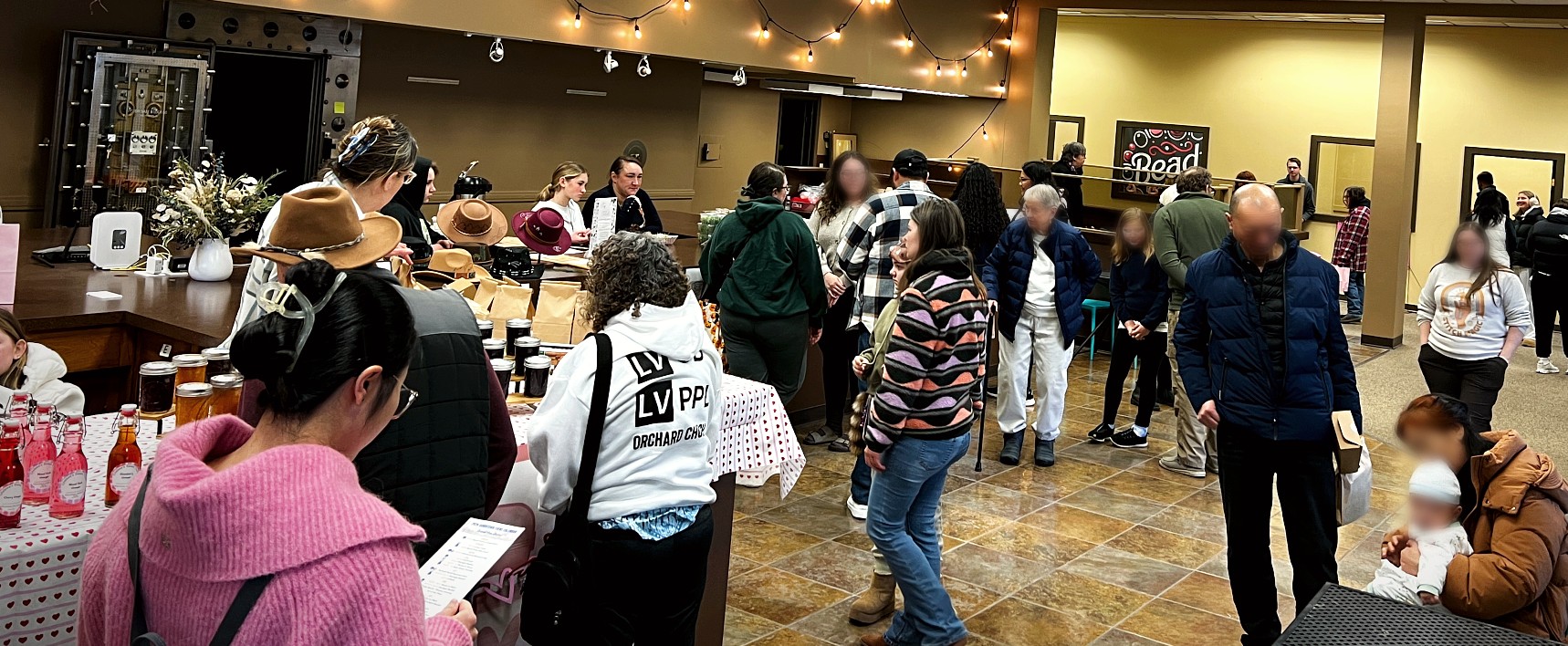
Pullman Market on Main is open Saturdays, 10am–3pm, at 300 E Main St.
That sentence sounds simple. It’s not.
Because the real opportunity here isn’t just “a place to shop.” It’s a place to test, learn, and launch. And if we do this right, Pullman Market on Main becomes a true entrepreneurship center for Pullman: a friendly, low-risk place where people can try an idea in public, get feedback fast, and either build momentum or pivot before they sink months (and a scary amount of money) into the wrong version.
That’s the whole point.
It’s not just a nice idea on a whiteboard either, it’s already happening. We’re seeing roughly 350–450 visitors per market, regular vendor sell-outs, and vendors having some of their best sales ever… week after week.
But first of all, huge credit to this community and our vendors, you’ve shown up, you’ve supported, you’ve sold out, and you’ve built brands that are honestly impressive. We’ve learned a lot from watching you do the work week after week. This next phase isn’t “us taking credit.” It’s us building more runway for the people already crushing it, and making it easier for the next wave of entreprecurious folks to grow.
We’re also putting together vendor case studies right now because what’s happening here is basically a real-world demand engine, no theory, just receipts.
Vendor signup (to learn more and get in touch)
Pullman entrepreneurship that happens in public
The market is already a startup (and that’s why it works)
Markets are built-in laboratories. They compress the hardest part of entrepreneurship into a few hours:
- Can you get someone to stop?
- Can you explain what you do in one breath?
- Can you price it without apologizing?
- Can you deliver quality, consistently, with real humans watching?
No pitch deck, no “stealth mode,” no hiding behind a logo.
Just: does the community want it?
And because Pullman Market on Main is kid-friendly and built to be welcoming, it’s the kind of place where people show up with curiosity and time, not just a shopping list. That matters. You can’t validate an idea if nobody talks to you.
Downtown Pullman revitalization starts with small wins
Why this matters right now for Pullman.
Pullman’s had a rough stretch of “Closed” signs. Most recently, the Lumberyard announced it’s closing at the end of January.
In the last year or so, we’ve also seen major local changes like:
- Foundry Kitchen & Cocktails closing downtown
- Thomas Hammer’s downtown location closing (with plans mentioned to reopen elsewhere)
- Pullman’s Arby’s closing
- And broader “what’s happening to Main Street?” pressure that’s been publicly discussed in local reporting
This blog post isn’t here to doom-scroll our downtown. It’s here to say the quiet part out loud:
If we want Pullman to thrive, we need a place where more people can start small, test fast, and build something real, without needing a full storefront, a business loan, or a miracle.
Pullman Market on Main is evolving into exactly that: a market first, and a Pullman revitalization project at a bigger scale.
How to start a business in Pullman without a storefront
What we mean by “entrepreneurship center.”
I was appointed executive director of a university entrepreneurship center because my background sits at the intersection of business ownership, marketing, and practical execution. When that ended, I focused on Pullman community outreach and pmwarner.com, where I work as a growth and marketing partner for founders, executives, and community builders who want results, not marketing theater.
So let me be blunt:
We’re not interested in theoretical entrepreneurship.
We’re interested in real businesses.
Real customers, real revenue, real operations and real “oh no, I forgot the Square charger.”
Pullman Market on Main is a natural on-ramp. If you’re “entreprecurious” (a perfectly respectable condition), this is where you can try the smallest version of your idea with the lowest possible risk.
Makers market Pullman: validate demand fast
Makers belong here (and always have)
When I say “entrepreneurship,” I’m not just talking about tech startups.
Pullman is full of makers: bakers, artists, woodworkers, designers, growers, DIY inventors, small-batch producers, and people who quietly build impressive things after work.
This space is built for them.
Because makers don’t need more advice. They need a place to test demand, build repeat customers, and learn what sells, without signing their life away on a lease.
Business coaching in Pullman built into the market
The team behind the scenes (and what we can help with to start a business in Pullman)
Pullman Market on Main isn’t run by “a committee.” It’s run by a practical team with complementary strengths.
Without turning this into a LinkedIn awards banquet (and without naming anyone who shouldn’t be named), the core expertise around the market includes:
- Finance and operational reality: pricing, basic forecasting, cash-flow hygiene (the unsexy stuff that keeps you alive)
- Marketing and customer development: messaging, offers, content, simple funnels, and repeat buyers (my lane)
- Brick-and-mortar and downtown small business experience: foot traffic patterns, merchandising, signage, customer experience, seasonal strategy
- Food, construction, produce, and hands-on building experience: what it takes to make a physical operation work in the real world
This matters because “try an idea” is only half the story. The other half is: can we help you grow it into something sustainable?
Yes. That’s the direction we’re taking.
Pop-up vendors in Pullman: test your idea before you go all in
What we’re offering now (and expanding next)
Here’s the practical version of “Pullman entrepreneurship center” that we can deliver immediately:
Pop-ups and test runs
Have an idea? Don’t wait until it’s perfect. Pop up. Test packaging, pricing, demand, and the pitch.
Vendor development (new and experienced)
We want to build up both first-timers and seasoned vendors. New vendors need confidence and fundamentals. Experienced vendors often need the next level: product expansion, better margins, better repeat business, and a clearer “why you.”
Free consultations and one-on-ones
If you’re serious about trying something, we can help you pressure-test it. Not with vibes. With questions, numbers, positioning, and next steps.
Coaching toward success or a pivot
Sometimes the right answer is “yes, go.” Sometimes it’s “not like that.” Pivoting early is a win, not a failure. It’s also dramatically cheaper.
Vendor case studies
We’re documenting real vendor stories right now, how they’re scaling, what changed, what worked, what didn’t, and what “best sales ever” actually looks like when you do it week after week.
Pullman entrepreneurship center: the logical steps to make it real
How we become Pullman’s entrepreneurship center
This doesn’t happen by declaring it on Instagram (though that’s a fun start). It happens by building simple systems the community can actually use:
Step 1: Make “try it here” the default
We normalize the idea that you can test a business in public without it being a big dramatic event. You don’t need permission. You need a plan and a table.
Step 2: Create a clear path from idea to first sale
A basic intake flow:
- What are you selling?
- Who is it for?
- What’s your price and your margin?
- What’s your minimum viable setup for a pop-up?
- What does “success” look like after 2–4 market days?
Step 3: Build a maker-friendly culture
The market becomes a place where makers belong, not where they “rent a spot.” That means welcoming onboarding, easy communication, and a culture that celebrates experimentation.
Step 4: Add coaching infrastructure (simple & repeatable)
Not a complicated program. A repeatable cadence:
- short consults
- fast feedback loops
- optional monthly clinics (pricing, branding, operations, etc.)
Step 5: Build partnerships and community (not competition)
PMOM’s role: we’re the on-the-ground test environment where you validate demand with real customers, fast. Then we can help connect you to the right next resources as you scale.
Pullman small business resources: the missing first step
Here’s the honest truth: a lot of people don’t need a 12-week program yet.
They need one Saturday.
In other words, they (YOU) need a low-risk way to find out if their idea actually works with real customers. They need confidence, clarity, and proof of demand, before they invest in branding, inventory, packaging, equipment, or a lease.
That’s what Pullman Market on Main is: the first step that’s been missing.
Pullman, if you’ve ever thought “would my idea work?” this is your test
If you’ve been sitting on an idea for months (or years), you don’t need more time. You need a test.
Pullman Market on Main can be your test kitchen, your storefront prototype, your focus group, your confidence builder, and your proof-of-demand engine, all in one place.
Show up on Saturday. Walk the market. Picture your table there.
Then let’s turn “maybe someday” into “we’re open.”
Vendor Signup
Pullman Market On Main website
FAQ: Pullman Entrepreneurship at Market on Main
How do I become a vendor at Pullman Market on Main?
Start simple: Email us or use our vendor signup form. We’ll ask what you’re selling, what setup you need, and what dates you want. If you’re brand new, we’ll help you plan a “first market” version that’s realistic and not a full Broadway production.
Do I need an LLC to sell at the market?
Usually, no. An LLC can be helpful for liability and structure, but it’s not a requirement to test an idea. In Washington, an LLC is something you may form, not something you must form to do business. That said: depending on what you’re selling and how you’re operating, you may still need a WA business license (see next question).
Do I need a Washington business license (UBI)?
Often, yes, especially if you’re selling goods to the public under a business name. Washington’s Department of Revenue says you need to register/get a business license if you meet any of several conditions, including:
- Using a name other than your full legal name
- Collecting sales tax
- Gross income of $12,000+ per year
- Needing city/state endorsements, etc.
Practical translation: if you’re selling most products at a market (and branding it as anything other than “Your Full Legal Name”), plan on getting licensed, and we can help you understand what applies.
Can PMOM help me set up an LLC or business basics?
We can help you think through the “right-fit” setup (sole prop vs LLC, naming, basic next steps, what questions to ask). For actually forming an LLC and dialing in legal/tax specifics, you’ll typically file through the state and/or talk with a professional. (We’ll point you to the right resources so you don’t end up in a 2 a.m. Google spiral.)
What can I sell?
Most “maker” products are fair game: art, crafts, packaged goods, home goods, candles, prints, apparel, vintage, specialty foods, etc. The big caveat is regulated categories (especially food). If it’s something people eat, drink, inhale, or put on skin, tell us early so we can help you do it the right way.
What if I want to sell food?
Food is where rules matter. In Whitman County, anyone serving or distributing food to the public generally needs approval/permit through the county’s temporary food establishment process. If you’re doing certain low-risk foods from a home kitchen (like baked goods, jams, candies, etc.), Washington’s Cottage Food Permit is often the path, and it exists because of Washington’s cottage food law (RCW 69.22.030).
Can I sell homemade baked goods without a commercial kitchen?
Sometimes, if your products qualify as “low risk” and you go through the Cottage Food Permit process, which is designed specifically for inspected home-kitchen production. If your food is higher-risk (or requires temperature control, complex prep, etc.), you’re usually looking at an approved kitchen and/or additional permitting.
Do I need to collect sales tax?
Many retail sales require sales tax collection, and WA DOR treats “selling a product/service that requires collecting sales tax” as one of the triggers for needing a business license. We’ll help you sanity-check what’s taxable and how to keep it clean.
I’m “entreprecurious.” Can I just test once before going all-in?
That’s literally the point of what we’re building. We’ll help you run a smart, small test: a tight product selection, clear pricing, and a simple goal (feedback and first sales). If it hits, we help you scale. If it doesn’t, we help you pivot, fast and without shame.
Quick Start: Test your business idea in Pullman this month
- Pick one product (or a tight set of 3–5) you can make consistently and sell with confidence.
- Set a simple goal for your first market: feedback & first sales (not “become Costco by noon”).
- Apply to vend here
- Want help with pricing, your pitch, or what to bring? Email us.
- Show up Saturday, 10am–3pm, and test it in front of real humans
FAQ – Full TEXT VERSION
How do I become a vendor at Pullman Market on Main?
Start simple: Email us or use our vendor signup link. We’ll ask what you’re selling, what setup you need, and what dates you want. If you’re brand new, we’ll help you plan a “first market” version that’s realistic and not a full Broadway production.
Do I need an LLC to sell at the market?
Usually, no. An LLC can be helpful for liability and structure, but it’s not a requirement to test an idea. In Washington, an LLC is something you may form, not something you must form to do business.
That said: depending on what you’re selling and how you’re operating, you may still need a WA business license (see next question).
Do I need a Washington business license (UBI)?
Often, yes, especially if you’re selling goods to the public under a business name. Washington’s Department of Revenue says you need to register/get a business license if you meet any of several conditions, including:
- using a name other than your full legal name
- collecting sales tax
- gross income of $12,000+ per year
- needing city/state endorsements, etc.
Practical translation: if you’re selling most products at a market (and branding it as anything other than “Your Full Legal Name”), plan on getting licensed, and we can help you understand what applies.
Can PMOM help me set up an LLC or business basics?
We can help you think through the “right-fit” setup (sole prop vs LLC, naming, basic next steps, what questions to ask). For actually forming an LLC and dialing in legal/tax specifics, you’ll typically file through the state and/or talk with a professional. (We’ll point you to the right resources so you don’t end up in a 2 a.m. Google spiral.)
What can I sell?
Most “maker” products are fair game: art, crafts, packaged goods, home goods, candles, prints, apparel, vintage, specialty foods, etc. The big caveat is regulated categories (especially food). If it’s something people eat, drink, inhale, or put on skin, tell us early so we can help you do it the right way.
What if I want to sell food?
Food is where rules matter. In Whitman County, anyone serving or distributing food to the public generally needs approval/permit through the county’s temporary food establishment process.
If you’re doing certain low-risk foods from a home kitchen (like baked goods, jams, candies, etc.), Washington’s Cottage Food Permit is often the path, and it exists because of Washington’s cottage food law (RCW 69.22.030).
Can I sell homemade baked goods without a commercial kitchen?
Sometimes, if your products qualify as “low risk” and you go through the Cottage Food Permit process, which is designed specifically for inspected home-kitchen production.
If your food is higher-risk (or requires temperature control, complex prep, etc.), you’re usually looking at an approved kitchen and/or additional permitting.
Do I need to collect sales tax?
Many retail sales require sales tax collection, and WA DOR treats “selling a product/service that requires collecting sales tax” as one of the triggers for needing a business license.
We’ll help you sanity-check what’s taxable and how to keep it clean.
I’m “entreprecurious.” Can I just test once before going all-in?
That’s literally the point of what we’re building. We’ll help you run a smart, small test: a tight product selection, clear pricing, and a simple goal (feedback and first sales). If it hits, we help you scale. If it doesn’t, we help you pivot, fast and without shame.
Also read How We’re Building a Farmers Market in Pullman and Pullman, Let’s Build Something Real at the Market on Main