
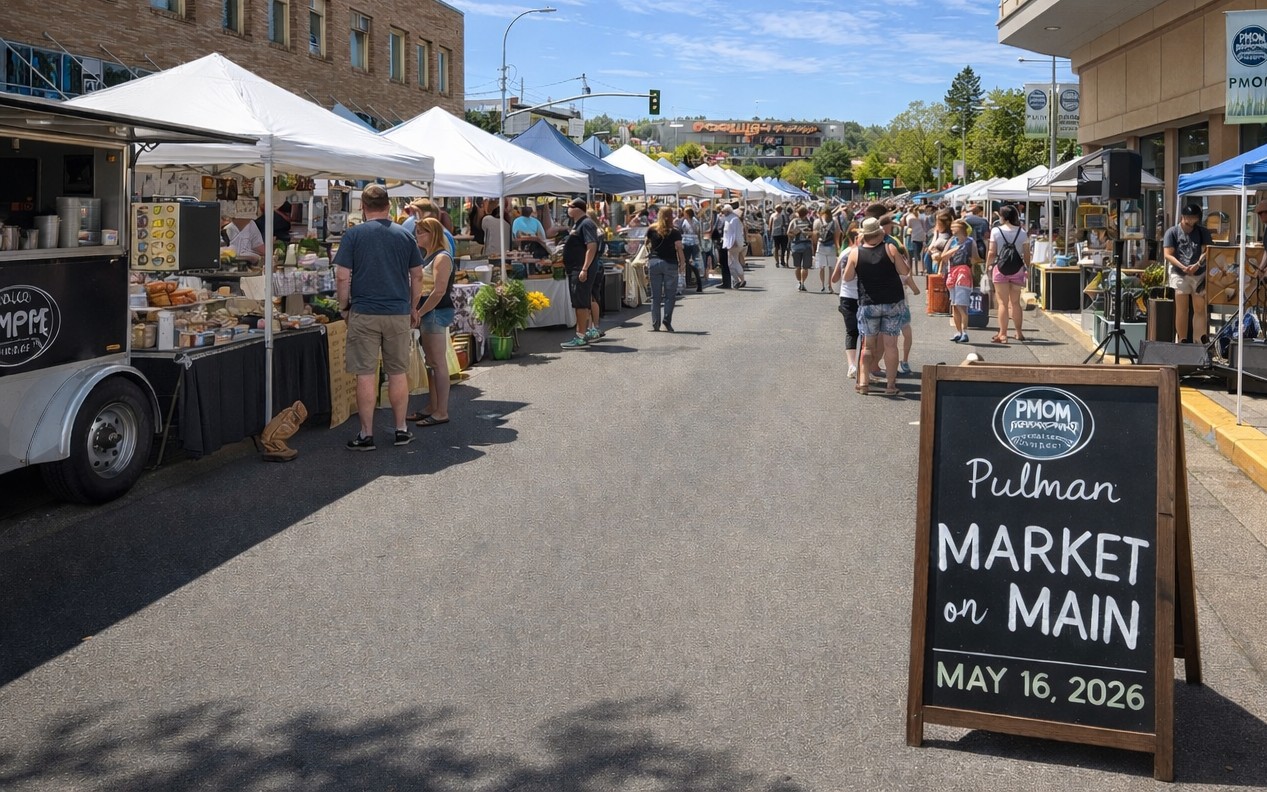
People see a room full of vendors, bags of fresh market finds, kids negotiating for cookies like tiny CEOs, and 300 to 350 neighbors cycling through the doors, and they assume the market is a tidy little money-maker.
It is not.
This is a post about the real math behind building a small-town market, why board members have spent thousands out of their own pockets to keep it moving, and why the most important truth is also the least romantic one: love can start a market, but love alone cannot run it every week forever.
Pullman has been incredibly supportive of this effort. That support is the reason I believe this can work long-term. But if we want it to last, we have to talk honestly about how markets operate, what they cost, and what sustainability really looks like when the goal is community impact, not profit.
The simple version everyone sees
Vendors pay $30 every Saturday.
That fee is intentionally low. We want entry to be accessible. We want first-time entrepreneurs, makers, growers, and small food businesses to be able to test an idea without a giant upfront risk. That is the point.
Keeping vendor fees low helps us do the things that matter:
- Support vendors and local entrepreneurs
- Help new businesses practice entrepreneurship in public
- Help makers and growers scale before they sign a lease
- Teach entrepreneurship the real way, by doing it
- Make downtown feel alive and connected
If we measure the market by community impact, vendor opportunity, and small business momentum, we are doing what we set out to do.
The math most never see
A market has baseline operating costs whether you have 8 vendors or 20. Insurance. Power, water, heating. Internet. Supplies. The basics required to operate responsibly and consistently.
There is a baseline cost to doing this right, and it shows up every month, whether the market is packed or it is a slower week. Even before permits, signage, cones, cleanup supplies, admin tools, and the hundred small needs that appear the moment you run a real event on a real schedule.
If you want an objective list of what “market operations” actually includes, the Farmers Market Coalition’s “How to Start a Farmers Market” guide lays it out clearly.
Now, revenue in plain terms:
- Indoors, we are averaging 10 to 12 vendors.
At the posted rate, that is $300 to $360 per Saturday. - Outdoors on Kamiakén, we are aiming for around 20 vendors.
At the posted rate, that is about $600 per Saturday.
One detail that matters for the real average: some vendors pay less when they are repeat vendors. We do that on purpose. Consistency matters, and we want to reward vendors who commit. It also means the market is not always collecting the full posted fee from every space every week.
So yes, growing vendor count helps. It still does not magically create a paid job, because outdoor markets also bring new costs and complexity, and we are keeping vendor fees low because we are building a runway for entrepreneurs, not a toll booth.
The hard part nobody wants to say out loud
Right now, the honest answer to “How is this sustainable if you are not paying yourself?” is:
It is a passion project.
We do it out of love for the community, and because Pullman has been so supportive. Board members have also covered real gaps with personal dollars, because we wanted the market to exist badly enough to keep it alive.
But it is also true that nobody should be expected to run a weekly operation forever without pay. Volunteers can come and go, and we are grateful for every hour. Still, the week-to-week work of planning, coordination, vendor communication, setup, market day execution, teardown, and follow-up is real.
If you want the unromantic research version of this, Oregon State’s extension write-up, “When Things Don’t Work: Some Insights into Why Farmers’ Markets Close”, is worth reading. The themes are familiar: overhead, staffing capacity, and burnout.
That is the crossroads every growing market hits. Either you keep it small enough to run casually, or you build the structure to run it reliably.
A quick clarification: this is about the role, not me
This is not a pitch to make me the market manager.
It is a pitch to recognize that a year-round market needs someone managing it consistently. A 20 to 30 hour per week market manager role for a passionate vendor or community member would give the market what every serious operation needs: a steady point of contact, vendor coordination, planning, accountability, and someone prepared to handle the Saturday details before Saturday morning arrives.
For context, I have a full-time job in Lewiston, a daily commute, and caregiving responsibilities at home for a sick spouse who cannot work. The year-round market workload on top of that means evenings, weekends, entire Saturdays, and the constant background hum of messages, planning, vendor questions, logistics, socials and problem-solving.
That can work for a season. It cannot be the operating model.
Right now, the market is being carried by people with jobs, businesses, families, bills, health realities, and lives outside the market. That is normal. What is not normal is expecting that kind of work to remain invisible, unpaid, and powered by goodwill forever. It is a slow-motion magic trick where people disappear.
Good intentions can launch something beautiful. Structure is what keeps it from quietly exhausting the people who built it.
The cost of a narrative (or, the emotional cost)
There is another cost that does not show up in a budget spreadsheet: narrative.
I understand gossip. It is entertaining. It is dramatic. It gives people something to talk about. It also rarely contains the whole truth, which is a small detail gossip tends to overlook.
And gossip does not just live online. In a small town, it moves quickly person to person. Someone hears a partial story at the coffee shop. Someone repeats it at dinner. Someone adds one extra detail because stories are more fun that way. Then it lands online and suddenly feels “confirmed,” mostly because it has become familiar.
We saw this up close when one vendor was repeatedly targeted in comments on our social posts. It was constant, and it got personal. That kind of behavior does not improve the market. It does not support vendors. It just burns people out and makes the community feel smaller.
There are a couple of useful words entrepreneurs should know and expect for this dynamic. Schadenfreude and Gluckschmerz. Fancy words, old habits.
As the philosopher Rico Richie said, “If you ain’t got no haters, you ain’t poppin’.”
Thick skin helps. But here is the operational point: handling real feedback, moderating noise, looking out for market workers and vendors, and responding to actual issues with consistency is work. In a paid role, that is part of the job. In a volunteer-only model, it is one more reason good people quietly step away.
What changes on May 16, 2026 and why it matters
On May 16, 2026, we move out onto the street.
I am excited about it. It is the version of a market most people picture: open air, more room for strollers, space for music, vendors visible from the street, and direct access to sunshine, which in the Palouse is both a gift and a scheduling gamble.
Outdoor markets also add real operational weight: permitting, safety planning, street closure logistics, added equipment, insurance requirements, and coordination that indoor markets do not need. None of this is bad. It is just real.
If you want a practical overview of how policy and permitting shape the workload, ChangeLab Solutions’ “From the Ground Up” is one of the clearest guides out there.
And here is the key point:
We are keeping vendor fees at $30.
Because vendors are the point. We are not building this to extract money from the entrepreneurs we are trying to support.
Grants help. They do not run Saturday.
We have been fortunate to receive some grant support, including an LTAC grant.
In practical terms, this helps us market the market. It helps us tell the story better, reach more people, and hire local content creators to build awareness.
It does not cover the ongoing day-to-day operations required to run a market every week. Marketing is necessary. It is not sufficient.
If you want to read more about the rules and guardrails, two good starting points are the state definition in RCW 67.28.080 and MRSC’s plain-language explainer, “Can We Spend Lodging Tax Funds on That?”. If you are curious how local programs can vary, here is one example of a grant packet that spells out limitations: City of Arlington lodging tax application.
So what does sustainability actually look like?
The best answer is to look 10 miles east.
Local comparison: Moscow Farmers Market
If you want a nearby example of a market that is community-centered and operationally sustainable, look at the Moscow Farmers Market.
Their secret is not that they found perfect volunteers. Their secret is that the market is treated like infrastructure, with paid staff and a city framework behind it.
Moscow’s Farmers Market Fee Proposal FAQs discuss staffing and operating context, including a full-time Market Manager role. You can also see city staffing tied to weekly execution in documents like the Administrative Specialist, Community Events job description, which explicitly includes on-the-ground support for implementing the weekly market. Moscow also describes the market as a city-managed community event in its Agency Resources.
They run seasonally, typically May through October, which creates an off-season for planning, handbook updates, vendor recruiting, and reset. That seasonality matters.
This model is worth studying, not because Pullman should copy Moscow exactly, but because it proves the bigger point: markets that last usually have a real operations backbone. Volunteers and boards are essential. Paid capacity is what makes it consistent.
Also, nationally, paying market managers is common. USDA’s National Farmers Market Managers report documents staffing patterns and the workload behind the role.
The Moscow lesson is not “copy Moscow.” (See Colfax and Lewiston) It’s this: lasting markets usually have support, whether that’s a city, chamber, downtown association, or staffed partner with the capacity to carry the weekly work.
How Pullman makes this sustainable without raising barriers for vendors
If we are committed to keeping vendor fees accessible, sustainability has to come from a second engine that supports operations.
Here are the options that tend to work in the real world:
1) Community support that covers the baseline
A “Friends of the Market” donations (tax deductible!) or recurring giving program.
Not charity. Investment. If baseline overhead is covered, vendor fees can remain accessible and the market can still fund operations.
2) Sponsorships that match the value the market creates
We are not just hosting booths. We are running a small business launchpad and a downtown magnet.
That has value to banks, major employers, healthcare organizations, real estate groups, and anyone who benefits from a healthier local economy.
3) Grants for growth, plus a plan for operations
Grants are great for marketing, special projects, and expansion. Operations still needs reliable funding, because operations happens every week whether or not a grant cycle is open.
4) A paid role that starts realistic and scales
A 20 to 30 hour market manager role is a practical starting point. It creates continuity, accountability, and a home base for vendor communication, planning, and market-day execution.
Continuity is what keeps a market from living and dying on one person’s unpaid stamina.
The truth I want Pullman to hear
We are achieving the community goals we set out to achieve. Pullman has shown up. Vendors have shown up. Customers have shown up.
The next step is simple, even if it is not easy: we need the structure to match the community’s enthusiasm.
I want this market to last. I want it to be something Pullman can count on. I want vendors to be able to build here, not just visit once.
And that means we graduate from passion project to sustainable institution, which includes paying the people doing the work.
If you are a business owner, a community leader, or someone who wants this market to exist five years from now, we would love to talk. (If this link doesn’t work, our email is: info@pullmanmarketonmain.org) Sponsorship, partnership, and community support are how markets survive while keeping vendor entry affordable.
Pullman has already proven it wants this.
Now we build the model that keeps it here.
References
- Farmers Market Coalition, “How to Start a Farmers Market”
https://farmersmarketcoalition.org/wp-content/uploads/2017/03/FarmersMarketGuide-online_version_lo-res.pdf - Oregon State Extension, “When Things Don’t Work: Some Insights into Why Farmers’ Markets Close”
https://extension.oregonstate.edu/sites/extd8/files/documents/sr1073.pdf - ChangeLab Solutions, “From the Ground Up”
https://www.changelabsolutions.org/sites/default/files/From_the_Ground_Up-Farmers_Markets_FINAL_20130415.pdf - Washington RCW 67.28.080, definition of tourism promotion and special events uses
https://app.leg.wa.gov/rcw/default.aspx?cite=67.28.080 - MRSC, “Can We Spend Lodging Tax Funds on That?”
https://mrsc.org/stay-informed/mrsc-insight/april-2022/can-we-spend-lodging-tax-funds-on-that - USDA NASS, “National Farmers Market Managers” (manager compensation and staffing patterns)
https://www.nass.usda.gov/Publications/Todays_Reports/reports/nfar0820.pdf - City of Moscow, Farmers Market Fee Proposal FAQs (market manager staffing context)
https://www.ci.moscow.id.us/DocumentCenter/Home/View/393 - City of Moscow, Administrative Specialist, Community Events (weekly market support in job duties)
https://www.ci.moscow.id.us/DocumentCenter/View/33677 - City of Moscow, Farmers Market page (May through October season)
https://www.ci.moscow.id.us/197/Community-Events-Moscow-Farmers-Market - City of Moscow, Agency Resources (market described as city-managed event)
https://www.ci.moscow.id.us/727/Agency-Resources - Arlington Lodging Tax grant application example (personnel costs restriction example)
https://arlingtonwa.gov/DocumentCenter/View/10750 - Merriam-Webster, schadenfreude
https://www.merriam-webster.com/dictionary/schadenfreude - Psychology Today, gluckschmerz
https://www.psychologytoday.com/us/blog/thoughts-on-thinking/202407/why-others-success-sometimes-irritates-us
Also read: Choose Your Partners Wisely (Because Success Makes Things Weird)
2 responses to “Building a Farmers Market: The Math, the Love, and the Part Nobody Puts on the Poster”
We never saw any negative gossip targeting a vender? We saw pressure being applied for venders to return, disclose their menu or items that they may bring. Please reach out if we can help comment or trouble shoot a problem poster.
Thank you. You have been an amazing supporter of vendors in this community. There’s not as much of an issue now, but there was definitely some “interesting,” non-constructive comments in the beginning of the indoor season. Thanks as always – you rock!